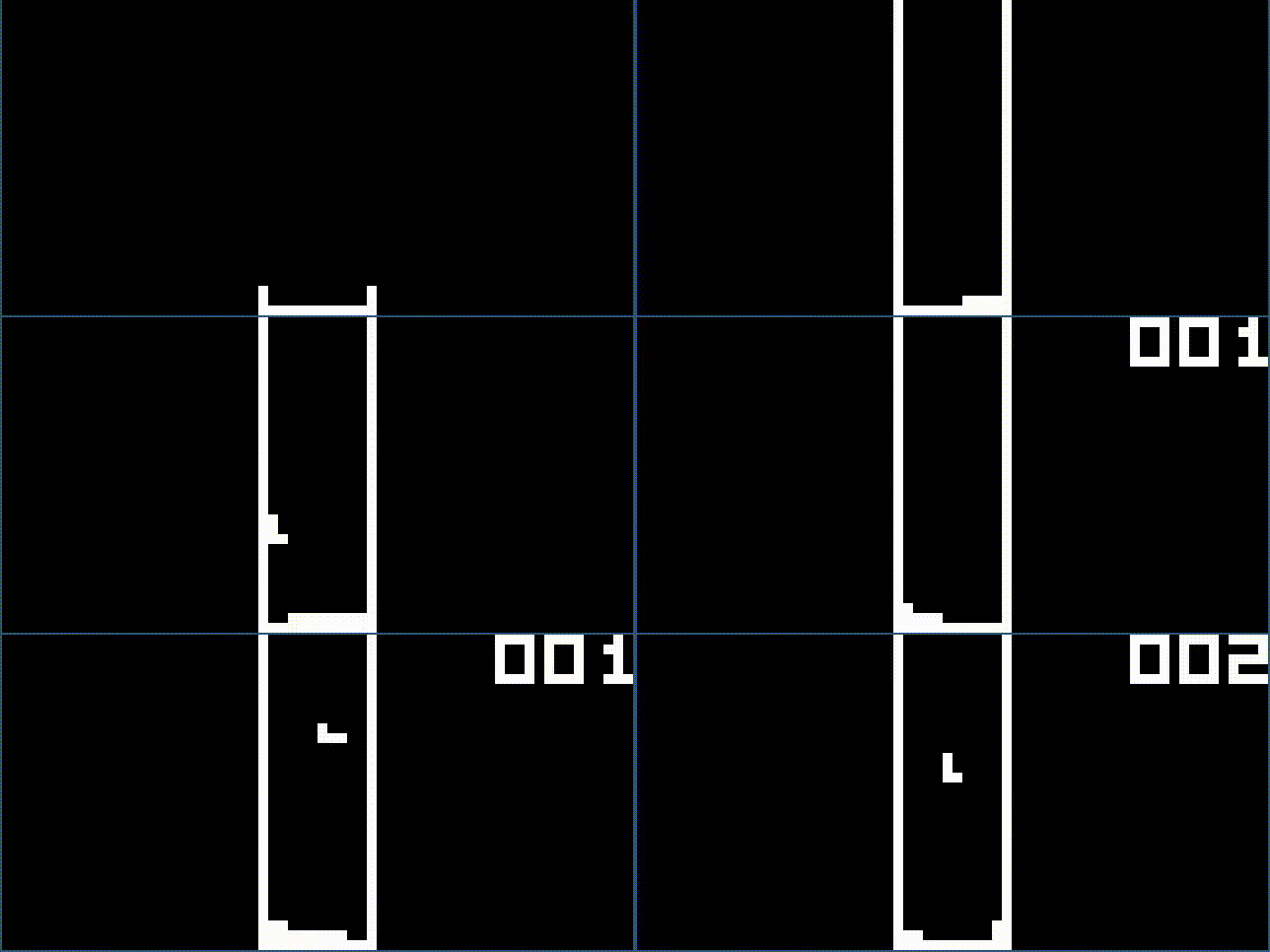
4096 bytes of address space, 16 registers, 34 instructions, and a 64×32 monochrome screen. A fetch-decode-execute loop dispatching through five function-pointer tables, an SDL3 layer that uploads the whole framebuffer as one streaming texture, and a 494-byte Tetris ROM that plays. C++17, one class for the machine and one for the window, no dependency on anything but SDL3 for the presentation layer.
CHIP-8 is not a CPU. It never had silicon. It’s an interpreted bytecode from 1977 that ran on a COSMAC VIP, which means writing an emulator for it is writing an emulator for a specification, with no hardware to appeal to when the spec is ambiguous. That turns out to be the interesting part.
I used Austin Morlan’s CHIP-8 article the way I’ve used every reference in this series: read it, take notes on the idea, close the tab, write the code from the notes. The architecture decisions, the SDL3 layer, the timing loop and all 34 instruction bodies are mine, and so are the bugs.
Three findings from this one, and they are all about the same thing, which is that a program that passes its tests and plays its game can still be wrong, and the only way to know is to measure something other than the output.
- The emulator scores 18/18 on an opcode test ROM and plays Tetris, and one of its 34 instructions is flatly wrong. I found it by instrumenting which handlers ever execute. Across both ROMs, 6 of the 34 never run once, and the broken one is in that set.
- A two-instruction ROM turns that wrong instruction into a segmentation fault, by way of two more latent bugs downstream of it. The program counter lands inside the built-in font, the font decodes as a valid opcode, and that opcode indexes a 102-entry table with a byte.
- The one bug the git history actually records was invisible for two days, because the instruction it broke has no observable effect until there is a display. Once there was one, I could put a number on it: the same test ROM goes from 18 OK / 0 NO to 16 OK / 2 NO.
If you only read one section, read Part 4.
Why an emulator, after three renderers
The raytracer taught me to derive maths instead of transcribing it. The ray marcher taught me to read code I didn’t write. The raycaster taught me that shipping a program rather than an image changes every decision, because a renderer that runs once can be wrong in ways only one camera angle reveals.
All three had the same escape hatch: I could look at the output and tell whether it was right. A fisheye bulge is visible. Inside-out normals are visible. Shadow acne is visible.
An emulator has no such property. The output of a correct 8xy5 and the output of a subtly incorrect 8xy5 are both “Tetris looks fine.” Correctness lives in a specification written for hardware I’ve never touched, and it is enforced, if at all, by ROMs someone else wrote in the 1970s. That was the whole reason to build one:
The deliverable is a machine whose correctness I cannot see.
Everything below follows from that constraint. It is why the debugging method inverted, why I ended up writing a coverage instrument, and why the most interesting bug in the project is one that nothing I ran ever triggered.
The rule about note-taking carried over unchanged. Read the lesson, take notes on the idea, close the tab, rebuild from the notes. Twenty-one commits over four days.
Architecture
graph TD
    A[main: parse argv, own the loop] --> B[app::ProcessInput]
    B --> C{elapsed > cycleDelay?}
    C -->|no| B
    C -->|yes| D[chip8::cycle_cpu]
    D --> E[fetch: memory PC, PC+1 -> opcode]
    E --> F[PC += 2]
    F --> G["masterTable[opcode >> 12]"]
    G --> H[Table0 / Table8 / TableE / TableF]
    G --> I[direct handler]
    H --> J[34 instruction bodies]
    I --> J
    J --> K[registers / memory / stack / displayBuffer]
    D --> L[decrement delayTimer, soundTimer]
    D --> M[app::Update: SDL_UpdateTexture, present]
    K --> M
| File | Responsibility |
|---|---|
chip8.h / chip8.cpp | The whole machine: registers, 4 KB memory, stack, timers, keypad, framebuffer, five dispatch tables, 34 instruction bodies, ROM loading |
app.h | SDL3 window, renderer, streaming texture, event pump, hex-keypad mapping |
app.cpp | One line: #include "app.h". The app layer is header-only; the .cpp exists so the build script has something to hand the compiler |
main.cpp | argv parsing, the timed loop, and the only place the two halves meet |
The address space it models:
| Range | Contents |
|---|---|
0x000 to 0x04F | Unused (on real hardware, the interpreter itself lived here) |
0x050 to 0x09F | The 80-byte hexadecimal font, 16 characters × 5 bytes |
0x0A0 to 0x1FF | Unused |
0x200 to 0xFFF | The ROM, 3584 bytes of it |
chip8 has no dependency on SDL and app has no dependency on chip8; main.cpp is the only translation unit that includes both. That’s the boundary that mattered, and it paid for itself immediately: every measurement in this devlog was taken by linking chip8.cpp against a twelve-line headless harness that runs N cycles and dumps displayBuffer as ASCII. No window, no event loop, no SDL at all.
It paid for itself because the state is public. registers, memory, displayBuffer and keypad are all public members, and main.cpp reaches straight into them. That is not a design I’d defend in a larger system, and I’ll come back to it, but it is what made the machine testable from outside without inventing an interface first.
Part 1: Decoding by table
A CHIP-8 opcode is 16 bits, and the top nibble tells you almost everything:
opcode = memory[programCounter] << 8u | memory[programCounter + 1];
programCounter += 2;
(this->*masterTable[opcode >> 12u])();
Sixteen possible top nibbles, sixteen table slots, one indirect call. Eleven of those slots point straight at an instruction. The other five (0x0, 0x8, 0xE, 0xF) point at a second table keyed by the low nibble or the low byte:
void chip8::Table8() { (this->*table8[opcode & 0x000Fu])(); }
void chip8::TableF() { (this->*tableF[opcode & 0x00FFu])(); }
The obvious alternative is a switch on the whole opcode, or nested switches. I went with tables for one reason that is worth stating precisely: a switch encodes the decode strategy in control flow, and a table encodes it in data. With tables, “which bits select the handler” is one expression per level, written once, and adding an instruction is an assignment in the constructor rather than a new case arm in a function that is already 200 lines long. It also happens to be exactly the shape a real instruction decoder has, which is a nice property for a project whose point is understanding how a decoder works.
The cost is that a table has a size, and a size is a claim about the range of the index. That claim is wrong in three of the five tables here, and Part 5 is about what it costs.
The one thing that did not compile. Filling the tables is where C++ makes you say what you mean:
table0[table08EsubTableIndex] = OP_NULL;          // error
table0[table08EsubTableIndex] = &chip8::OP_NULL;  // fixed in commit c3be6cd
A pointer-to-member function is not a function pointer, and the name of a member function is not implicitly convertible to one. You have to spell out &chip8:: because the thing being stored isn’t an address in the ordinary sense: it’s an offset plus a calling convention, resolved against a this that doesn’t exist yet. Hence the calling syntax, which is genuinely ugly and genuinely honest:
(this->*masterTable[opcode >> 12u])();The this->* is not ceremony. It is the object being supplied at the call, because it could not be supplied at the store.
The other type error in the same commit was subtler and had nothing to do with tables:
std::uniform_int_distribution<uint8_t> randomByte;   // undefined behaviour
std::uniform_int_distribution<unsigned int> randomByte;  // the fix
The standard permits uniform_int_distribution to be instantiated on short, int, long, long long and their unsigned versions, and nothing else. uint8_t is a typedef for unsigned char, which is not on that list. Every major implementation compiles it and most of them work, which is exactly what makes it dangerous: it is undefined behaviour that manifests as a portability bug on whichever platform you didn’t test. Widening to unsigned int and masking with the opcode’s low byte costs nothing and is actually defined.
Part 2: Testing the decoder before writing the semantics
Commit 7fde1ee is called “Added placeholder functionality” and it makes all 34 handlers do this:
void chip8::OP_8xy4() { std::cout << std::hex << opcode << ": OP_8xy4\n"; }Two commits later, c3be6cd wires up the fetch, adds a main.cpp that runs 100 cycles against a ROM, and nothing else. The machine could not add two numbers, and the decoder was fully tested.
This is the part of the process I’d defend hardest, and it’s a straight lift of how the hardware itself is organised. Decode and execute are separate stages, so they should be separately wrong. With every handler a no-op, the program counter marches linearly from 0x200 and each cycle prints the opcode it fetched next to the handler it dispatched to. Two failure modes (dispatched to the wrong handler and the handler computes the wrong thing) are cleanly separated, and the first one is checkable by eye against the opcode printed beside it.
There is a detail here I only noticed reconstructing the history: the ROM used for that decoder test was Tetris. The file committed as test.ch8 in c3be6cd is byte-identical to the tetris.ch8 added six commits later; a real game was serving as an opcode-stream generator before a single instruction existed. That is a better fixture than a hand-written one, for two reasons. A real ROM has a realistic opcode distribution, so the common paths get hammered and the rare ones show up as gaps. And because every handler is a no-op, the PC walks straight through the ROM’s data as well as its code, decoding tables and sprite bytes as if they were instructions, which is precisely the input distribution you want when the thing under test is a decoder and not a program.
It also, three days later, turned out to be the exact input distribution that hides Part 4.
Print the quantity, don’t render it. For three projects the debugging method was the opposite: write the value you suspect into the framebuffer and look at it, because a 640×480 debug image tells you more in one second than a breakpoint hit 307,200 times. That method needs the quantity to have a picture. A dispatch decision doesn’t. So the trace printer is the debug image here, and the thing that makes it work is the same thing that made the normal-map trick work: one line per event, scanned at a glance, rather than one breakpoint per event, inspected in a debugger.
Part 3: The mask that was in the wrong coordinate space
This is the one bug in the git history, and its commit message is Added Display instruction and fixed bug for reading and writing [I]. Here is the entire fix:
 void chip8::OP_Fx55()
 {
-    uint8_t Vx = (opcode >> 8u)& 0x0F00u;
+    uint8_t Vx = (opcode >> 8u)& 0x000Fu;
FX55 writes registers V0 through Vx into memory starting at I; FX65 reads them back. Both need x, the second nibble of the opcode. There are two correct ways to extract it and this file contains both:
uint8_t Vx = (opcode >> 8u) & 0x000Fu;   // shift down, then mask the nibble
uint8_t Vx = (opcode & 0x0F00u) >> 8u;   // mask in place, then shift down
Twenty-seven of the twenty-eight sites that extract x use the first. OP_Fx33 is the single one that uses the second. They are equivalent, and the bug is neither of them. The bug is the hybrid: shift down like the first, then apply the mask belonging to the second. 0xF155 >> 8 is 0xF1; 0xF1 & 0x0F00 is 0. The mask was written for the bit positions the value had before it was shifted.
So Vx was always 0, and both instructions silently degraded into “save and restore V0, and nothing else.” Not a crash. Not a wrong address. Just fifteen registers quietly not participating.
That is the exact shape of the assert bug from my raycaster, where a bounds check validated a global coordinate against a local array. Same category, different domain: a mask is a statement about which coordinate space its operand is in, and nothing in the type system records that. uint16_t is uint16_t whether the nibble you want is at bit 8 or bit 0. The compiler cannot help, and it did not warn, because there is nothing wrong with the expression, it computes zero correctly.
Why it survived two days. Look at the commit it was fixed in. FX55/FX65 are pure state movement between registers and RAM; on their own they produce no output at all. The decoder test in Part 2 couldn’t catch it because the decoder was fine. It became observable in exactly the commit that added OP_Dxyn, because that is the commit where the machine gained the ability to show the contents of a register. The bug was fixed the same hour the emulator grew a screen, and that is not a coincidence (it is the definition of observability).
Putting a number on it. Reverting just those two masks and re-running the opcode test ROM through a headless harness:
| Build | Cells passing | Cells failing |
|---|---|---|
| As shipped | 18 OK | 0 NO |
With the pre-fix mask on FX55 only | 17 OK | 1 NO (row 4) |
| With the pre-fix mask on both | 16 OK | 2 NO (rows 4 and 5) |
The ROM draws a grid of labelled cells, each reading OK or NO, and I scanned the framebuffer for the two 8×4 glyph pairs directly rather than squinting at ASCII art. Breaking FX55 alone flips exactly one cell; breaking FX65 alone flips exactly the other. Two lines, two cells, causally pinned.
Which raises the obvious question, and it is the whole next section: the test ROM catches this one. What doesn’t it catch?
Part 4: What the test ROM does not test
The emulator scores 18 out of 18 on the opcode test ROM and plays Tetris for as long as I care to keep playing. Both of those facts are true and neither of them is evidence of very much, because there is a quantity underneath them that nobody measures: which handlers ever execute.
So I measured it. Same headless harness, plus a counter keyed on the decoded opcode class, run over both ROMs.
| ROM | Cycles | Distinct handlers exercised |
|---|---|---|
test.ch8 (opcode test) | 5,000 | 22 of 34 |
tetris.ch8 | 200,000 | 17 of 34 |
| Union of both | 28 of 34 |
Six of the thirty-four instruction bodies in this emulator have never executed once. Not “rarely”. Not “only in edge cases”. Zero times, across a purpose-built conformance ROM and two hundred thousand cycles of real gameplay:
| Never executed | What it does |
|---|---|
00E0 | CLS = clear the display |
8xy7 | SUBN = reverse subtract |
Fx0A | LD Vx, K = block until a key is pressed |
Fx18 | LD ST, Vx = set the sound timer |
Fx29 | LD F, Vx = point I at a font character |
Bnnn | JP V0, addr = jump to nnn + V0 |
That last one is wrong.
void chip8::OP_Bnnn()
{
    programCounter = memory[opcode & 0x0FFFu] + registers[0];
}
The instruction is “jump to address nnn plus the contents of V0.” What this does is read the byte stored at address nnn and jump to that. It dereferences the operand instead of using it. A and B are adjacent nibbles, Annn legitimately loads an address into I, and this is what happens when you write the two of them in the same sitting.
The consequence is deterministic and, once you see it, faintly funny. memory[] holds uint8_t and registers[0] holds uint8_t, so the sum is at most 510. The ROM is loaded at 512. The buggy instruction is arithmetically incapable of jumping anywhere in the program, ever. It always lands in the interpreter-reserved region below 0x200, which on this machine contains 80 bytes of font and 4016 bytes of zero.
I wrote a two-instruction ROM to watch it happen:
0x200:  6000     LD V0, 0
0x202:  B300     JP V0, 0x300        ; spec: PC = 0x300. this build: PC = memory[0x300] + V0
0x300:  50       ; one byte, placed so the buggy jump has somewhere to go
pc=200 op=6000
pc=202 op=B300
pc=050 op=F090        <- the program counter is now inside the font
Segmentation fault
The jump lands at 0x050, which is the first byte of the character 0 in the font table. The font’s first two bytes are F0 90, and F090 is a perfectly well-formed opcode: top nibble F, so dispatch through TableF, which indexes on the low byte:
chip8func tableF[0x65 + 1];                      // 102 entries
(this->*tableF[opcode & 0x00FFu])();             // index range 0 .. 255
0x90 is 144. The table has 102 entries. The read is out of bounds, the value fetched is whatever the object happens to contain past the end of tableF, and it is then called as a pointer-to-member function. That is the segfault, in a plain optimised build with no sanitizer involved.
Three latent bugs, chained, reachable from four bytes of ROM. A wrong operand puts the PC in the font; the font is valid-looking code; the code indexes a table with a value the table was never sized for. Any one of them alone is a shrug. Together they are a crash that nothing in my test suite, nothing in the game, and nothing in the opcode test ROM will ever produce.
What I actually take from this. I did not find this by testing harder. The test ROM is a good test ROM and it is green. I found it because I stopped asking “does it pass” and asked “what did it run”, and those are different questions with different instruments. Coverage is not a testing nicety here; it is the only thing standing between “18/18” and “18/18, on 82% of the code.”
And the six never-executed handlers are not a random sample. Look at what they are: clear-screen, reverse-subtract, block-on-key, the sound timer, the font pointer. They are the instructions that a small ROM has no reason to use. Untested code concentrates in the corners of a specification, and a conformance suite written against typical programs will systematically miss the atypical ones. That is a general property of test corpora, not a fact about CHIP-8, and it is the reason “we have tests” and “we have coverage” are not interchangeable claims in any codebase I will ever work in.
Part 5: Every array here has a bound nobody wrote down
Once tableF turned out to be indexable past its end, the obvious move was to check the rest. Every array in chip8 is a fixed-size member, every index is derived from ROM data, and in four cases out of five the two do not agree.
| Array | Declared size | Index expression | Reachable range | Agrees? |
|---|---|---|---|---|
masterTable | [0xF + 1] = 16 | opcode >> 12 | 0 to 15 | yes |
table0, table8, tableE | [0xE + 1] = 15 | opcode & 0x000F | 0 to 15 | off by one |
tableF | [0x65 + 1] = 102 | opcode & 0x00FF | 0 to 255 | off by 154 |
memory | 4096 | index + i, programCounter | 0 to 4110 | no |
displayBuffer | 2048 | (yPos+row)*64 + xPos+col | 0 to 2950 | no |
Only masterTable is right, and it is right for a structural reason: a 4-bit index has exactly 16 values and the table has exactly 16 slots, so the size is the range. Every other table is sized to the largest opcode that happens to be valid rather than to the largest index the expression can produce. table8 stops at 0xE because 8xyE is the last legal 8 instruction; but 8xyF is a perfectly reachable 16-bit value, and nothing between the ROM and the array subscript rejects it.
The display buffer is the one that should worry you most, because it is written, not read. Dxyn wraps the sprite’s origin and then adds to it:
uint8_t xPos = registers[Vx] % 64;
uint8_t yPos = registers[Vy] % 32;
...
uint32_t *screenPixel = &displayBuffer[(yPos + row) * 64 + (xPos + col)];
The modulo wraps the starting coordinate. Nothing wraps or clips xPos + col or yPos + row. A 15-row sprite starting at (63, 31) computes a maximum index of 2950 into a 2048-element array. That is 3608 bytes past the end of the buffer.
Here is what lives there:
sizeof(chip8)  = 14992 bytes
displayBuffer  = bytes  4168 .. 12360
opcode         = byte  12360
RNG state      = bytes 12368 .. 12384
dispatch tables= bytes 12384 .. 14992   <- 2608 bytes of pointer-to-member function
(g++ on x86-64; the exact offsets are ABI-dependent, the ordering is not.)
A sprite drawn near the bottom-right corner XORs 0xFFFFFFFF over the emulator’s own dispatch tables, and then keeps going past the end of the object entirely. The machine’s instruction decoder is downstream of its framebuffer in memory, and the framebuffer has no upper bound.
I want to be precise about how bad this actually is, because “reachable” and “reached” are different words. I instrumented the write itself (not the computed index, the actual XOR) and ran both ROMs:
| ROM | Cycles | Sprite writes past the buffer |
|---|---|---|
test.ch8 | 5,000 | 0 |
tetris.ch8 | 200,000 | 0 |
| my five-instruction sprite ROM | 4 | 34, immediately |
Tetris comes close. It draws a 4-row sprite at (30, 29), whose bottom row computes indices 2078 to 2085 (past the end) but the sprite’s bottom row happens to be blank in those columns, and the write only happens if (spritePixel). The bound is violated by the address computation on every frame and saved by the contents of the sprite. That is not a safety property. That is luck with good timing.
The fix is not a bounds check, it is a decision. There are two defensible behaviours for a sprite that runs off the edge (clip it, or wrap it to the opposite edge) and real CHIP-8 programs depend on which one you pick. The current code implements a third thing, which is “index into whatever is next in the struct,” and it implements it because nobody chose. A missing bound is usually a missing decision wearing a bounds check’s clothes.
The same reasoning applies to memory. Fx55 writes memory[index + i] for i up to 15, with index a 12-bit value that can be 0xFFF, so a ROM can write 15 bytes past the end of a 4 KB array whose successor in the struct is index itself. And load_rom reads a file straight into memory + 0x200 with no size check at all, so a 4 KB ROM overruns the address space by 512 bytes into the display buffer and the keypad.
load_rom has one more property worth naming:
std::ifstream rom(fileName, std::ios::binary | std::ios::ate);
if (rom.is_open()) { /* ... */ }
// no else
A path that doesn’t exist produces no error, no message, and no non-zero exit. Memory stays zero-filled, 0x0000 decodes to masterTable[0] → table0[0] → OP_00E0, and the emulator sits there clearing an already-blank screen, 333 times a second, forever, until the PC walks past 4095 and starts fetching out of bounds. A typo in a ROM path produces a black window and total silence. Twelve lines of error handling would turn the most likely user mistake in the entire program into a one-line diagnostic.
Part 6: Three clocks, one knob
The CHIP-8 specification describes three independent rates. The CPU executes instructions at whatever speed the host manages, roughly 500 to 1000 per second on a VIP. The delay and sound timers decrement at exactly 60 Hz, independent of the CPU. The display refreshes at whatever the display refreshes at.
Here is cycle_cpu:
opcode = memory[programCounter] << 8u | memory[programCounter + 1];
programCounter += 2;
(this->*masterTable[opcode >> 12u])();

if (delayTimer > 0) delayTimer--;
if (soundTimer > 0) soundTimer--;
And here is the loop that drives it:
if (dt > static_cast<float>(cycleDelay))
{
    lastCycleTime = currentTime;
    chip8Core.cycle_cpu();
    mainApp.Update(chip8Core.displayBuffer, videoPitch);
}
The timers decrement once per instruction, and the display presents once per instruction. All three rates have collapsed onto a single number, cycleDelay, passed on the command line. The shipped launch script uses 3:
The timers are supposed to run at 60. They run at 5.6× the specified rate, and the test script’s 1 makes it 16.7×.
This is not a cosmetic issue, because Tetris uses the delay timer as its clock. In 200,000 cycles it executes Fx15 (set delay timer) 799 times and Fx07 (read delay timer) 316 times; the piece fall rate, the input repeat rate and the line-clear animation are all LD DT, n followed by a busy-wait on LD Vx, DT. On real hardware that wait is n/60 seconds regardless of CPU speed, that is the entire reason the timers are specified as an independent 60 Hz clock. Here the wait is n instructions, because each instruction in the wait loop decrements the very timer it is polling.
So the game’s speed depends on cycleDelay twice, in opposite directions, and the two effects don’t cancel (they multiply). Turning the CPU down to make the game slower also turns the timers down, which makes every timed delay complete in the same number of instructions it always did. The knob labelled “emulation speed” cannot actually change the ratio of anything to anything.
The fix is small and I want to be clear that it is small, because the interesting part isn’t the fix:
// timers advance on their own 60 Hz accumulator, in the loop, not in cycle_cpu
timerAccumulator += dt;
while (timerAccumulator >= 1000.0f / 60.0f) {
    if (delayTimer) delayTimer--;
    if (soundTimer) soundTimer--;
    timerAccumulator -= 1000.0f / 60.0f;
}
Two accumulators (one for CPU cycles, one for timers) and the display presents when the framebuffer is dirty rather than when an instruction retires. That’s maybe fifteen lines.
What’s worth extracting is why the collapse happened at all. cycle_cpu is named for one job and does three, and the two extra ones got in because they are mentioned in the same paragraph of the spec as the fetch-decode-execute cycle. Proximity in a document became proximity in a function, and a function that ticks three clocks has silently asserted that they are the same clock. Every independent rate in a system deserves its own accumulator, and the moment two of them share one, the system has lost the ability to express the difference between them. That is the same failure shape as the depth buffer in my raycaster (two different quantities stored in one float, with nothing recording the difference) except that here the two quantities are times, and the loss is invisible because both of them still tick.
Part 7: The display layer, and the bug that monochrome hides
The framebuffer is uint32_t displayBuffer[64 * 32], where every pixel is either 0x00000000 or 0xFFFFFFFF. That is 8192 bytes to store 2048 bits, a 32× overhead, on a machine whose entire address space is 4 KB.
It’s the right call, and it is worth saying why, because “wasteful” and “wrong” are not synonyms. The buffer is not modelling the CHIP-8 display. It is modelling the SDL texture, so SDL_UpdateTexture takes a pointer to it and uploads it with no packing, unpacking or conversion step:
SDL_UpdateTexture(texture, nullptr, buffer, pitch);It also makes Dxyn trivial. A CHIP-8 sprite pixel is one bit and a screen pixel is 32, so they cannot be XORed directly, but a sprite bit that is set means “invert this pixel”, and inverting a pixel that is all-zeros-or-all-ones is ^= 0xFFFFFFFF. One instruction, no branch on the current value, collision detection falling out of a comparison against the same constant.
The cost is that the constant 0xFFFFFFFF now appears in three places (the clear, the collision test, the XOR) and each occurrence independently assumes the encoding. Change the pixel format and the collision test in Dxyn doesn’t fail to compile, it just quietly stops detecting collisions, which in Tetris means pieces stop landing. An invariant spread across three call sites with no owner is the same problem as the sprite bound in Part 5, one abstraction level up.
And there’s a bug here that cannot fire, which is the interesting part. The texture is created as:
SDL_CreateTexture(renderer, SDL_PIXELFORMAT_RGBA8888, SDL_TEXTUREACCESS_STREAMING, 64, 32);In my raycaster I spent real time on exactly this line, because SDL names pixel formats by byte order within a 32-bit word, most significant first, not by their order in memory. So a little-endian buffer with red in the low byte is ABGR8888, and guessing RGBA8888 swaps red and blue on every pixel. It looks like a rendering bug and it sends you into the wrong file.
Here, RGBA8888 is what’s written, and it is invisible whether it’s right or wrong. 0xFFFFFFFF is identical under every permutation of its bytes, and so is 0x00000000. A monochrome framebuffer cannot distinguish a correct pixel format from an incorrect one, in precisely the way that a 512×512 framebuffer cannot distinguish a correct row stride from an incorrect one, which is the bug that cost me a day on the last project.
That is now twice, in two consecutive projects, that a degenerate value has deleted a whole class of bug from my ability to observe it. I’m treating it as a rule: when a test fixture makes two things equal, it has stopped testing the difference between them. Square buffers hide strides. Monochrome hides channel order. Zero-filled memory hides load failures. The fixture that catches the most bugs is the one where every dimension, channel and constant is deliberately distinct.
One more thing about the SDL3 layer, carried over deliberately from last time: none of the initialisation is checked. SDL_Init, SDL_CreateWindow, SDL_CreateRenderer and SDL_CreateTexture all return values that this constructor ignores. I knew the SDL3 convention going in (success is true, not 0, inverted from SDL2) and wrote the constructor anyway with no checks, because the emulator was the interesting part and the window was scaffolding. That’s a defensible priority and an indefensible constructor: a chip8 object that fails to get a window still runs, still executes ROMs, and still returns 0 from main.
Bugs, and how I found them
| Symptom | Cause | Fix |
|---|---|---|
table0[i] = OP_NULL refused to compile | A member function’s name is not convertible to a pointer-to-member; the object isn’t available at the store | &chip8::OP_NULL, and (this->*table[i])() at the call -> Part 1 |
FX55/FX65 moved only V0 | (opcode >> 8u) & 0x0F00u = shifted like one idiom, masked like the other, so Vx was always 0 | & 0x000Fu. Measured: the test ROM goes 18 OK → 16 OK / 2 NO -> Part 3 |
| Nothing. 18/18 and Tetris plays | Bnnn dereferences its operand: memory[nnn] + V0 instead of nnn + V0. Never executed by either ROM | Found by measuring handler coverage, not by testing -> Part 4 |
| Segfault from a 4-byte ROM | Bnnn → PC lands in the font → F090 decodes → tableF[0x90] indexes a 102-entry array | Size the tables to the index range, not to the last valid opcode -> Part 5 |
| Timers run 5.6× fast at the shipped settings | cycle_cpu decrements both timers once per instruction; the loop presents a frame per instruction too | Separate accumulators for CPU and 60 Hz timers -> Part 6 |
| Silent black window | load_rom has no else on is_open(); zeroed memory decodes as 00E0 forever | Report the failure and exit non-zero |
if (stackPointer < 0) never fires | stackPointer is uint8_t; -Wtype-limits says comparison is always false due to limited range of data type | Check == 0 before the decrement, not < 0 after it |
memset compiles on clang, fails on g++ | <cstring> is never included; the MSVC headers pull it in transitively and libstdc++ does not | Include what you use |
The method that found the last four is the one I’d point at. The trace printer and the headless harness are the same tool at two scales. chip8.cpp has no dependency on SDL, so linking it against a twelve-line main that runs N cycles and dumps displayBuffer as ASCII costs nothing, runs in milliseconds, and can be re-linked with any single line of the emulator deliberately reverted. That is how the 18-vs-16 measurement in Part 3 was taken, how the coverage table in Part 4 was taken, and how the out-of-bounds write counts in Part 5 were taken. Every number in this devlog is a g++ invocation away from being reproduced.
The thing that made that possible was a design decision I’d previously have filed under “obviously correct, not interesting”: keeping the machine free of the presentation layer. It stops being a tidiness argument the moment you want to run the machine ten thousand times without a window.
What I’d do next
Ordered the way I’d actually pick them up.
- Size the dispatch tables to their index ranges.
table0,table8andtableEbecome 16 entries,tableFbecomes 256, all prefilled withOP_NULL. This is four characters of change and it converts the crash in Part 4 into a silent no-op, which is the correct behaviour for an undefined opcode. Everything else on this list is optional; this one is not. - Fix
Bnnn:programCounter = (opcode & 0x0FFFu) + registers[0]; - Decide what
Dxyndoes at the screen edge, then implement the decision. Clip or wrap, either is defensible; indexing past the framebuffer into the dispatch tables is not. - Give the timers their own 60 Hz accumulator, take them out of
cycle_cpu, and present a frame when the framebuffer is dirty rather than when an instruction retires. ThencycleDelaybecomes a CPU-speed knob that means what its name says. - Error-handle
load_rom: report a failed open, and reject a ROM larger than4096 - 0x200bytes instead of writing it into the framebuffer. - Replace
OP_Fx0A’s sixteen-branchif/else ifchain with a four-line loop. It’s the one handler in the file that is long for no reason, and the loop is also more correct: the chain always reports the lowest-numbered key held, which silently makes key 0 win every simultaneous press. - A
Nibbletype, or at minimum onevx(opcode)helper. Thirty-four handlers extract the same two nibbles by hand, in two different idioms, and Part 3 is what happens when someone blends them. One function, used everywhere, and the bug in Part 3 becomes unwritable rather than merely fixed. - A CHIP-8 disassembler, which is thirty lines given the tables already exist, and would have made Part 4 a five-minute investigation instead of an hour. Being able to print
0x2B4: LD VB, 0x1Anext to a trace line is the emulator equivalent of rendering the normal map. SDL_AUDIOfor the sound timer.Fx18is implemented, has never executed, and drives a beeper that does not exist. It is the only instruction whose output device is missing entirely.- The stack, properly. Sixteen entries,
stack[stackPointer++]with no check on either end, and a guard against underflow that the compiler can prove is dead.
What I took away
“It passes” and “it ran” are different measurements, and only one of them is about the code you wrote. The opcode test ROM is green. Tetris plays. Eighteen out of eighteen. And six of thirty-four instruction bodies had never executed, one of them was wrong, and reaching it crashes the process. Nothing about running the tests harder would have surfaced that, it needed a different instrument pointed at a different quantity. Every project in this series has had a moment where the answer was stop reasoning and measure; this is the first one where the thing worth measuring wasn’t a number in the output at all.
A missing bound is usually a missing decision. tableF is 102 entries because 102 is where the valid opcodes stop, and Dxyn walks off the framebuffer because nobody chose between clipping and wrapping. In both cases the array size is standing in for a decision that was never made, and the compiler dutifully encoded the non-decision as a number. When I find an off-by-N now, my first question is no longer “what should the bound be” but “what was the bound supposed to be deciding”.
Observability is a feature with a ship date. The FX55 bug existed for two days and was fixed within an hour of the emulator gaining a display, because for those two days the machine had no way to show the contents of a register. That is not a story about carelessness. It is a story about the fact that a bug you cannot observe does not exist yet, operationally, and that the highest-leverage work is often the work that makes other bugs visible rather than the work that fixes them. The trace printer in Part 2 and the headless harness in Part 4 are both that same investment, at different points in the project.
When a fixture makes two things equal, it stops testing the difference. A square framebuffer can’t tell a right stride from a wrong one. A monochrome framebuffer can’t tell RGBA8888 from ABGR8888. Zero-filled memory can’t tell a loaded ROM from a missing file. That’s three, across two projects, and I now deliberately pick fixtures where every dimension and every constant is distinct, for the same reason you never test a matrix library with the identity.
The boundary I drew for tidiness turned out to be the test harness. chip8 knowing nothing about SDL looked like ordinary hygiene when I wrote it. It is the reason I could link the machine against a twelve-line main, run it two hundred thousand cycles in a few milliseconds, revert one line at a time, and put actual numbers in this devlog instead of adjectives. Decoupling is usually sold as a maintenance argument. Its real return, at least here, was measurement.
Build
Source: kads1024/emulator-chip8
clang++ -std=c++17 -fms-compatibility main.cpp app.cpp chip8.cpp \
    -o main.exe -I. -ISDL3 -Llib/x64 lib/x64/SDL3.lib
SDL3 headers and prebuilt libraries for x86, x64 and arm64 are vendored in the repo, so the only prerequisite is a C++17 compiler. Copy lib/x64/SDL3.dll next to main.exe.
main.exe <scale> <cycle-delay-ms> <rom>

main.exe 10 3 tetris.ch8     # the demo above
main.exe 10 1 test.ch8       # the opcode test ROM
The COSMAC VIP’s hex keypad is mapped onto the left of a QWERTY keyboard, Esc quits:
CHIP-8 keypad          Keyboard
1 2 3 C                 1 2 3 4
4 5 6 D      -->        Q W E R
7 8 9 E                 A S D F
A 0 B F                 Z X C V
To reproduce any measurement in this devlog, link chip8.cpp against a main that constructs a chip8, calls load_rom, loops cycle_cpu(), and prints displayBuffer. The state is public, so no other scaffolding is required.
Reference material: Austin Morlan’s CHIP-8 emulator article, read as a set of lessons rather than a codebase. It is where I learned that opcode dispatch wants to be a table. The architecture, the SDL3 layer, the timing loop, all 34 instruction bodies and every bug above are mine, and the git history is the record of which is which.